
Why India Moving from LPG to PNG Matters — And Why You Should Care#
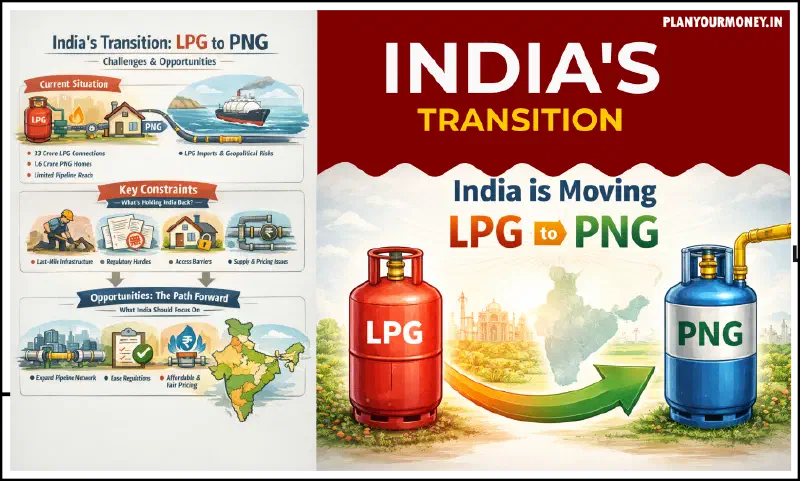
India is quietly going through an important energy transition — from LPG cylinders to piped natural gas (PNG). On the surface, this may look like just another infrastructure story. But if you zoom out, it has deep implications for your household cost, the economy, and even inflation.
Let’s break this down simply.
1. The Bigger Picture: Why This Shift Matters#
Today, India imports almost 100% of its LPG needs, while nearly 50% of PNG demand can be met domestically.
This difference is not small — it’s strategic.
Now think about this scenario:
LPG comes via ships through critical routes (like the Strait of Hormuz) If anything disrupts this:
1. Shipping costs go up
2. Insurance costs go up
3. Supplier countries charge more
4. Intermediaries add margins
End result: You pay more for the same cylinder
But it doesn’t stop there.
1. Higher import cost → Trade deficit increases
2. Trade deficit → Rupee weakens
3. Rupee weakens → Imports become even costlier
4. Costlier imports → Inflation rises
This is a classic macroeconomic loop.
So when India pushes PNG, it is not just about convenience — it is about breaking this cycle.
2. So Why Isn’t Everyone Already Using PNG?#
Good question. If PNG is so beneficial, why hasn’t it scaled like LPG?
Here are the real constraints:
Infrastructure is the biggest bottleneck#
1. Pipelines need to be laid under roads
2. In cities like Bangalore, this means:
    - Digging roads
    - Managing traffic disruption
    - Getting multiple approvals
This slows everything down.
Apartment & RWA challenges#
1. In standalone homes, easier
2. In apartments:
    - RWAs need to approve
    - Residents must agree
    - Safety concerns are debated
Consensus becomes a hurdle
Switching friction at household level#
- Existing LPG stoves may not work directly
- Requires minor modification or replacement
- People prefer “don’t fix what isn’t broken”
Execution speed is slow#
- Even though pipelines are planned, rollout is gradual
- India needs to accelerate this significantly
Under-utilization of existing connections#
- Even where PNG is available:
- Not all households actively use it
3. Why PNG Still Makes Sense for You#
Despite these challenges, PNG offers clear, tangible benefits:
Lower dependency on imports#
50% domestic production reduces pressure on:
    - Trade deficit
    - Currency
Indirectly helps control inflation
No cylinder logistics#
- No booking
- No waiting
- No sudden “gas finished” moments
Continuous supply = peace of mind
Reduced traffic & logistics cost#
- Fewer delivery trucks on roads
- Less congestion
- Lower fuel usage overall
Transparent usage & billing#
Meter-based billing Easier to track consumption
With PNG, this visibility helps optimize usage — something LPG doesn’t offer easily.
4. How You Can Actually Get PNG#
If PNG is available in your area, the process is fairly straightforward via GAIL Gas Limited:
Typical steps:#
1. Submit application (online/offline)
2. Provide:
    Address proof
    Identity proof
3. Site inspection
4. Pipeline connection setup
5. Meter installation
You can check the official process here: https://gailgas.com/products/application-procedure
5. A Practical View: PNG vs LPG vs Induction#
If you look at it from a long-term lens:
LPG → Convenient, but import-heavy and inflation-sensitive PNG → Stable, continuous, infrastructure-driven future Induction → Even more advanced (electric, clean, scalable)
Your thought is directionally right:
If possible, the next level is induction cooking, especially as India’s electricity mix improves.
Final Thought#
India’s move from LPG to PNG is not just policy — it’s a structural shift toward energy stability.
From a personal standpoint, adopting PNG means:
- Less dependency on global shocks
- More predictable costs
- Better convenience
And from a country’s standpoint, it means:
Lower imports → Stronger rupee → Lower inflation pressure
Meanwhile Parag Parikh Flexicap Fund bought Indraprastha Gas and Mahanagar Gas in February 2026.
Reference#
In case you would like to understand more about my services , please go through this document or you could email me.